
On Thursday, Oil Minister Dharmendra Pradhan had stated that the government was reworking the subsidy-sharing formula.

Teheran bargains on OilMin plan for more rupee payment via increased import; wants investment deal on gas block.

The government on Friday cleared disinvestment in two bluechip state-owned companies IOC and Bhel, which would fetch over Rs 7,300 crore (Rs 73 billion) to the exchequer in the current fiscal.

Petroleum Minister Dharmendra Pradhan was to give away the awards but he could not attend because he was travelling.
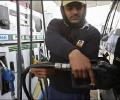
Fuel retailers sell diesel, domestic LPG and kerosene at government controlled rates which are below market price. The loss they thus incur is made good through cash subsidy from the government and dole from upstream firms like Oil and Natural Gas Corporation.

OVL, the overseas investment arm of state-run explorer Oil and Natural Gas Corporation, holds 40 per cent stake in the San Cristobal oil project in Venezuela.

Following up on Finance Minister Arun Jaitley's Budget announcement of creating an integrated oil company, India's biggest oil and gas producer ONGC may buy all of the government's 51.11 per cent stake in Hindustan Petroleum Corporation Ltd.

OVL, the overseas arm of state-run explorer Oil & Natural Gas Corporation, and Oil India Limited agreed in June last year to jointly buy Videocon's 10 per cent interest in the Rovuma Area 1 for $2.475 billion.
The President noted that the green shoots of recovery were already visible, with the economy growing at 5.7 per cent during the first quarter of current fiscal.

OVL had bid for two of the 10 shallow-water blocks that Myanmar had auctioned in December but drew a blank when the fields were awarded on March 26.

The acquisition of stake in Progress Energy Resources Corp's shale gas assets and Pacific NorthWest LNG for 1 billion Canadian dollars ($900 million) marks IOC's maiden entry into North America.

The Petroleum Ministry has asked for Rs 26,000 crore (Rs 260 billion) as fuel subsidy for the third quarter of this financial year, but the finance ministry is inclined to provide only Rs 10,000 crore (Rs 100 billion) cash support.

Lines up a $1-billion capital expenditure plan for exploration purposes abroad.

A deal with the Assam government, which holds majority stake in the company through Assam Industrial Development Corporation Ltd, is likely by October.

Making sense of the international crude market is incredibly hard.
.jpg)
The Oil Ministry on October 31 issued orders asking upstream oil and gas producers like ONGC and Oil India Ltd to give Rs 16,729.74 crore (Rs 167.29 billion) to make up for 47 per cent of the Rs 35,328-crore (Rs 353.28 billion) revenue that retailers lost on selling diesel, domestic LPG and kerosene at government controlled rates in second quarter.

The FinMin will pay Rs 5,324 crore (Rs 53.24 billion) for Jan-March.

RIL has been selling gas from KG-D6 at the same price since it started production in April 2009.
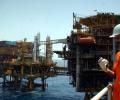
Oil India is set to usher in a new era with a road map drawn to ramp up production and diversification plans to foray into liquefied natural gas

ONGC Videsh Ltd and Oil India Ltd will buy Videocon Industries' 10 per cent stake in a giant Mozambique gas field for $2.475 billion.

At present, in Myanmar, GAIL and IndianOil have a minority stake in a gas pipeline which goes to China, through South East Asia Gas Pipeline Company.
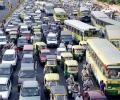
India has already pipped Japan as the world's third-largest oil consumer.
The FM should quietly get the oil companies to offload the shares in the market and pocket the gains
The reserves in Farzad-B are almost thrice the largest gas field in India.
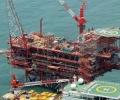
The government will decide in August whether to sell a 5 percent stake in ONGC, a senior oil ministry official said, in a deal that would be worth $2.9 billion at current market prices.

Cabinet may tweak Rangarajan formula; new price may be further delayed.
According to a new subsidy sharing formula, the payout of upstream oil producers like ONGC is to be reduced to the extent of Rs 4,500 per tonne oil development cess they pay to the government, sources privy to the development said.
.jpg)
With Oil Ministry continuing to be opposed to selling IOC shares on stock market like other disinvestments, an Empowered Group of Ministers headed by Finance Minister P Chidambaram today decided to sell 24.27 crore shares or 10 per cent government stake in the company to Oil and Natural Gas Corporation and Oil India Ltd.

The report, 'Road Ahead Clears Up for Oil PSUs', says the decline in underrecoveries, or losses oil-marketing companies incur on selling petroleum products below market price, will have a significant positive impact on both upstream and downstream public-sector oil companies.

The commission asks for notification to be deferred; RIL's KG-D6 pricing issue may return to Cabinet
